Meet Your Instructor: A Note from Filip Maletic, PhD
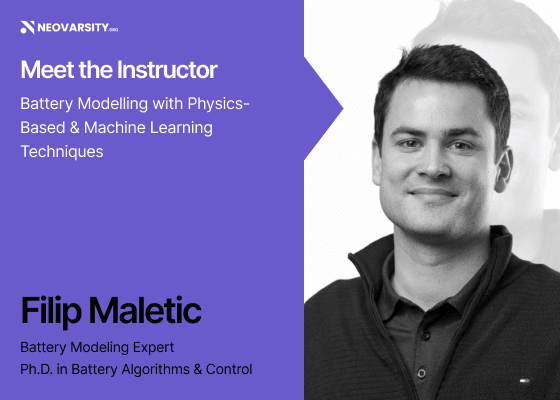
Filip Maletic, instructor of ‘Battery modelling with physics based & ML techniques’, shares his journey, motivation, and course takeaways.
3 min read
June 13th, 2025
Last updated: June 13th, 2025


Top Startups Using Physics and ML for Battery Development
A new generation of battery startups is merging machine learning with physics-based modeling to crack industry bottlenecks. This roundup provides a list of the top innovators reshaping the battery industry with hybrid intelligence.
Hi, I’m Filip Maletic, and I’m excited to be your instructor for the Battery Modeling and Machine Learning course at Neovarsity. I’ve spent the past several years diving deep into the world of lithium-ion batteries, both in academia and industry, and I’m passionate about helping others bridge the gap between complex theory and real-world modelling.
My Journey into Battery Modeling
I’ve always been a curious and driven engineer. My academic background centers on battery algorithms and control, and I earned my Ph.D. working on advanced battery state-estimation techniques and data-driven aging modelling.
After my Ph.D., I joined AVL List GmbH, one of the world’s largest automotive consultancies. At AVL, I worked as a Battery Modelling Engineer, developing custom multiphysics battery models that captured electrochemical, thermal, and mechanical behaviors, all across a range of scales, from detailed microscale , over simplified pseudo-2D continuum, to cell-level 3D distributed models.
That experience helped me appreciate just how critical accurate modeling is, not only for understanding batteries but for designing the next generation of systems that rely on them.
Modeling isn’t just about math. It’s about translating physical behavior into something reliable and predictive.
Why I Teach
When I started learning battery modeling, I noticed something: a lot of the available resources were either too 'theoretical' or too 'tool-specific'.
I wanted to create a course that gives people both the intuition and the hands-on skills to work confidently with battery models whether you’re a researcher, engineer, or data scientist.
In this course, I aim to guide you through that learning curve. We’ll start from first principles and build up to powerful hybrid models that combine physics-based insights with data-driven flexibility.
What You’ll Learn with Me
The Battery Modeling and Machine Learning course is designed to give you a solid foundation and practical experience. Here’s what we’ll cover together:
What is a battery, how does it work, and how can - as well as why should - it be modelled
Physics-based modelling of the main electrochemical reactions: full 3D microscale, reduced continuum scale (p2D), and cell-level distributed 3D approaches
How to model the effects of internal heat generation and outside thermal management, and couple it to the main electrochemical model
How, and why, does the battery “breathe”, and how can that mechanical effect be modelled and coupled back to the main models
How to implement and simulate the models numerically in Python (using PyBaMM and NGSolve packages)
How does the battery age, and should it be modelled by a data-driven rather than physics-based approaches
Project-based work that connects the physics-based simulation and data-driven aging modelling
Throughout the course, I’ll also share best practices in numerical modelling, battery modelling parametrization, scientific programming, and model interpretability. These nuances have proven useful in both my research and industry work.
Let’s Build the Future Together!
I’ve designed this course for people who are motivated to understand batteries at a deeper level and who want to build tools that are not just operational but scalable as well.
Whether you're looking to accelerate your research, boost your industry skills, or explore a new technical area, I’m here to guide you. I believe battery modeling is one of the most exciting and impactful fields to be in right now and I’m looking forward to helping you make your mark.
See you in the course!
— Filip
Applications are open now
The next cohort begins on June 16 and space is limited. 👉 Explore the curriculum and apply here
For questions, contact Catherine at [email protected].
And if you know someone working in batteries, energy, or applied ML, pass this along! The battery industry needs more hybrid thinkers.
Neovarsity is a Berlin-based deep tech skills platform. We build industry-driven, cohort-based programs in collaboration with world-class experts to prepare talent and teams to solve problems in areas with real-world impact.
Stay tuned for more updates and insights. Follow us on LinkedIn and join the conversation using #FutureThroughDeepTech.
Looking to upskill for high-impact roles in battery modelling?
This course teaches you how to model batteries using physics-based simulations and machine learning. You will gain:
- Fluency in Python-based battery simulation and ML integration
- Tools to accelerate your workflow and modeling accuracy
- Portfolio-ready outputs, including simulation plots and ML performance reports